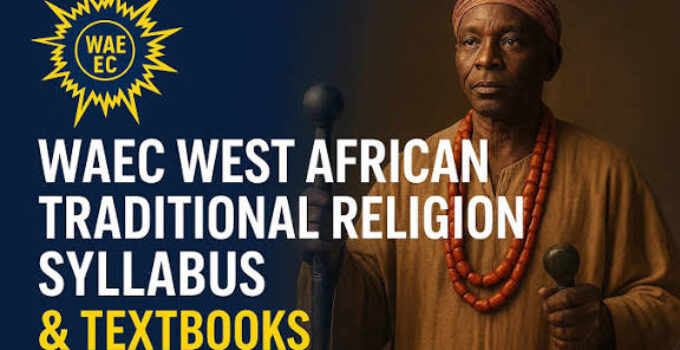
WAEC CRS Syllabus 2026/2027 & Recommended Textbooks — The Christian Religious Studies Syllabus is designed to help candidates understand the beliefs, values, and practices that shaped traditional African societies and continue to influence modern life.
This subject goes beyond rituals; it explains how religion, culture, morality, and community life are deeply connected in West Africa.
Read also:
Overview of WAEC CRS 2026/2027 Syllabus
Whether you are preparing for the WAEC essay and objective examinations or searching for a clear breakdown of the syllabus, this guide explains everything you need to know in a simple and exam-focused manner.
The Christian Religious Studies examination consists of two papers, taken in one sitting:
Paper 1: Objective Test
50 multiple-choice questions
Duration: 50 minutes
Total marks: 40
Paper 2: Essay Test
Three sections (A, B, and C)
Candidates must answer four questions, selecting at least one question from each section
Duration: 2 hours 10 minutes
Total marks: 60
Aims and Objectives of the WAEC CRS Syllabus
The WAEC Syllabus for CRS/CRK is structured to ensure that candidates:
Gain a clear understanding of West African traditional religious beliefs and practices
Appreciate the moral and ethical values that guide traditional societies
Learn how traditional principles can be applied to everyday life
Analyze the influence of religion on social, political, and economic development
Understand how modern changes affect traditional religious systems
WAEC CRS Syllabus 2026/2027| Recommended Textbooks
The syllabus is divided into three major sections, each focusing on key aspects of West African Traditional Religion.
SECTION A: General Introduction to West African Traditional Religion
This section introduces candidates to the foundation of Waec CRS, including:
Meaning, nature, and characteristics of Christian Religious Studies (CRS)
Belief in the Supreme Being, divinities, ancestors, and mystical powers
Reasons for studying Christian Religious Studies (CRS)
Common terms such as animism, totemism, monotheism, and polytheism
Sources of WAEC CRS Syllabus, including:
Oral traditions (proverbs, myths, songs, drum language)
Non-oral sources (traditional arts and crafts)
Names and attributes of God in West African societies
Approaches to studying WAEC CRK syllabus (thematic, comparative, historical)
Structure of WAEC crs syllabus:
God
Ancestors
Divinities
Charms and amulets
Worship practices:
Prayer and libation
Sacrifice
Spirit possession
SECTION B: The Individual and the Community
This section focuses on how religion affects personal life and communal living:
Religious personalities and leadership roles
Selection and functions of priests, diviners, and traditional leaders
Festivals:
Types and significance
Religion and medicine:
Herbal and traditional healing
Relationship between traditional and orthodox medicine
Concept of time, work, and wealth
Concept of man, destiny, and enemies of life
Witchcraft and magic:
Meaning, acquisition, and societal role
Religion and ethics:
Moral values
Taboos and sin
Covenants
Rites of passage:
Birth and naming
Puberty
Marriage
Death and burial rites
SECTION C: Contemporary Society
This section explains how WAEC CRK Syllabus interacts with modern life:
Traditional political institutions:
Chieftaincy and Asafo companies
Religion and tourism:
Sacred places, objects, and personalities
Religion and stress management
Conflict resolution and peacebuilding
Reproductive health and hygiene
Impact of Christianity and Islam on WATR
Influence of science, technology, and urbanization
Environmental conservation
New religious movements such as:
Afrikania Mission (Ghana)
Godianism (Nigeria)
The future of West African Traditional Religion
Why Studying the Christian Religious Studies Syllabus 2026/2027 Is Important
Understanding the WAEC CRS/CRK syllabus helps candidates:
Answer exam questions confidently
Develop cultural awareness
Understand African values and identity
Prepare effectively for both objective and essay questions
Final Exam Preparation Tips
Focus on definitions and explanations
Use real-life examples in essay answers
Practice past questions regularly
Understand key terms and cultural concepts
Manage time effectively during the exam
Practice has been proven to be a pillar to perfection, this acknowledges the idea of studying guidelines that helps you build and note the target areas and some related questions and areas of concentration in most Exams, information is power, ensure you get the right information before you go into any of the Christian Religious Studies (CRS) Examination 2026/2027, Always visit the WAEC portal http://www.waeconline.org.ng

