Get the complete WAEC Jan/Feb Physics Practical Questions and Answers. See the full apparatus list, diagrams, likely questions, food tests, and expert tips to score high in Physics practical. Every year, WAEC Physics practical remains one of the most feared papers among science students. Not because it is impossible, but because many candidates walk into the laboratory without fully understanding what WAEC expects.
If you are writing 2026 Jan/Feb and May/June WAEC Physics Practical, this guide was written for you.
The WAEC Physics practical examination is designed to test how well you can handle apparatus, take measurements, draw accurate graphs, and apply physics principles practically, not how well you cram theory.
In this article, you will learn:
- What the WAEC Physics Practical really looks like
- The common apparatus and experiments to expect
- Real past WAEC Physics practical questions and answers
- Where and how to add practical images for maximum SEO
- Proven examiner tips to score high
If you want to pass Physics in one sitting, do not skip this guide.
WAEC Physics Practical 2026/2027: PDF, Past Questions, Diagrams & Examiner Secrets
What Is WAEC Physics Practical 2026/2027?
The 2026/2027 WAEC Physics Practical is a compulsory laboratory exam where candidates perform experiments, take readings, plot graphs, and answer questions based on observations.
Unlike theory, marks here are practical and visible. WAEC awards marks for:
- Correct setup of apparatus
- Accurate readings
- Neat tables
- Proper graph plotting
- Logical calculations
- Clear conclusions
NOTE: Most WAEC Physics practical questions are repeated yearly with slight modifications, which makes early preparation extremely powerful.
Physics Practical Format (What to Expect)
The Physics practical exam usually lasts 1 hour 30 minutes and consists of two major questions:
Question 1: Mechanics / Electricity Experiment
This may involve:
- Simple pendulum
- Hooke’s law (spring)
- Motion on an inclined plane
- Electrical circuit (Ohm’s law)
Question 2: Optics / Heat / Waves
This may involve:
- Reflection using mirror
- Refraction using glass block
- Focal length of lens
- Heating and cooling experiment
You will be asked to:
- Record readings
- Complete a table
- Plot a graph
- Calculate slope
- Draw conclusions

WAEC Physics Practical 2026/207: PDF, Past Questions, Diagrams & Examiner Secrets
Common Practical WAEC Physics Apparatus (Very Important)
You should be familiar with these:
- Metre rule
- Stopwatch / stop clock
- Retort stand and clamp
- Spiral spring
- Slotted masses
- Ammeter and voltmeter
- Rheostat
- Connecting wires
- Glass block
- Ray box or pins
- Thermometer
- Beaker
- Heat source
WAEC does not introduce strange equipment. Everything is basic and repeated.
REAL 2026/2027 Practical WAEC Physics Past Question (Mechanics)
Question (Past WAEC)
A spiral spring is suspended from a rigid support. A mass hanger and slotted masses are added gradually, and the corresponding extension of the spring is recorded.
(a) Tabulate your readings
(b) Plot a graph of load against extension
(c) Determine the slope of the graph
(d) State one precaution taken
Sample Answer Breakdown
(a) Table of Readings
| Load (N) | Extension (cm) |
|---|---|
| 0.5 | 2.0 |
| 1.0 | 4.1 |
| 1.5 | 6.1 |
| 2.0 | 8.0 |
| 2.5 | 10.2 |
✔ Neat table = marks
(b) Graph
- Vertical axis: Load (N)
- Horizontal axis: Extension (cm)
- Straight-line graph passing through origin
Important: Always label axes correctly.
(c) Slope Calculation
[
\text{Slope} = \frac{\Delta Load}{\Delta Extension}
]
[
= \frac{2.5 – 0.5}{10.2 – 2.0} = \frac{2.0}{8.2} \approx 0.24 , N/cm
]
(d) Precaution
- Ensure the spring is not overstretched
- Take readings at eye level to avoid parallax error
View the image below:
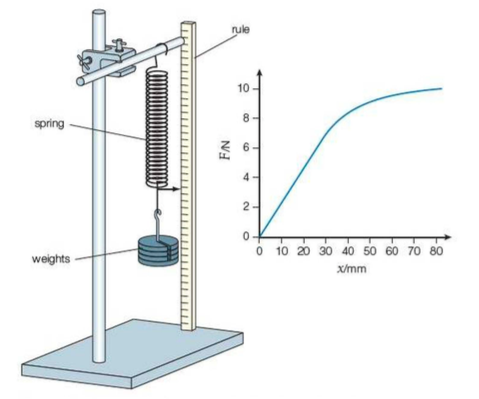
fig 1. Photo of Hooke’s law practical setup with spring and masses: WAEC Physics Practical Hooke’s Law Experiment 2026
REAL Practical WAEC Physics Past Question (Electricity)
Question
The circuit shown consists of a battery, a rheostat, an ammeter, a voltmeter, and a resistor.
(a) Record values of current and voltage
(b) Plot a graph of voltage against current
(c) Determine the resistance
(d) State one source of error
Sample Answer
(a) Table
| Voltage (V) | Current (A) |
|---|---|
| 1.0 | 0.2 |
| 2.0 | 0.4 |
| 3.0 | 0.6 |
| 4.0 | 0.8 |
| 5.0 | 1.0 |
(b) Graph
- V on vertical axis
- I on horizontal axis
- Straight line
(c) Resistance
[
R = \frac{V}{I} = \frac{5}{1} = 5 , \Omega
]
(d) Source of Error
- Internal resistance of the battery
- Poor contact in connecting wires
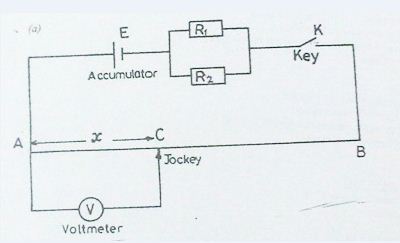
fig 2. Photo of WAEC Physics practical electrical circuit: WAEC Physics Practical Ohm’s Law Circuit Diagram
REAL 2026/2027 Practical WAEC Physics Past Question (Optics)
Question
A glass block is placed on a drawing paper. Two pins are fixed and the path of a ray is traced.
(a) Measure angle of incidence and refraction
(b) Calculate refractive index
(c) State one observation
Sample Answer
Formula
[
n = \frac{\sin i}{\sin r}
]
If:
- ( i = 45^\circ )
- ( r = 28^\circ )
[
n = \frac{\sin 45}{\sin 28} \approx 1.5
]
Observation
- The ray bends towards the normal
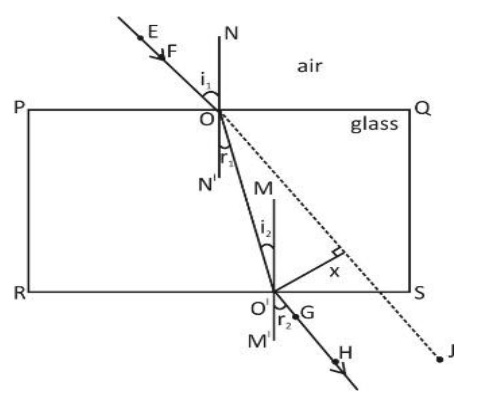
fig 3. Ray diagram showing refraction through glass block: WAEC Physics Practical Refraction Glass Block Diagram
READ ALSO:
WAEC Physics Syllabus 2026/2027 | Recommended Textbooks
How To Answer WAEC Questions in 2026/2027
WAEC Timetable 2026: Latest Updates, How to Get It & Exam Guidelines
Common Mistakes WAEC Candidates Make
Every year, examiners report the same issues:
- Wrong graph scale
- Poor axis labeling
- Untidy tables
- Missing units
- No precautions written
- Rough or faint graphs
Avoiding these alone can boost your score significantly.
Examiner’s Secret Marking Tips
WAEC examiners love:
- Straight, bold graphs
- Logical calculations
- Correct units (cm, N, V, A)
- Clear handwriting
- Short, accurate answers
They do not reward long stories.
How to Prepare Effectively for 2026/2027 WAEC Physics Practical
- Practice at least 10 past practical
- Master graph plotting
- Memorize standard precautions
- Learn common sources of error
- Know your formulas
- Practice reading instruments
Physics practical is skill-based, not guesswork.
Why This Guide Matters
Many students fail Physics not because they are weak, but because they ignore practical preparation.
The truth is simple:
If you understand past WAEC Physics practical questions, you already know 70% of the exam.
FREQUENTLY ASKED QUESTIONS(FAQS)
Question: What is WAEC Physics Practical 2026/2027?
Answer: Physics Practical is the laboratory-based examination where candidates perform experiments, take measurements, plot graphs, and answer questions based on observations using standard physics apparatus.
Question: What experiments should I expect in Physics Practical 2026?
Accepted Answer: Candidates should expect experiments on mechanics (such as Hooke’s law or simple pendulum), electricity (Ohm’s law), optics (reflection or refraction), and heat or waves. These experiments are usually repeated with slight variations.
Question: Is WAEC Practical repeated every year?
Accepted Answer: Yes, WAEC Physics practical questions are often repeated yearly with minor changes in values or apparatus. Practicing past questions greatly increases the chances of success.
Question: How is WAEC Physics Practical marked?
Accepted Answer: WAEC awards marks for correct setup, accurate readings, neat tables, properly labeled graphs, correct calculations, stated precautions, and clear conclusions. Neat presentation and correct units are very important.
Question: What apparatus are commonly used in WAEC Physics Practical?
Accepted Answer: Common apparatus include metre rule, stopwatch, retort stand, spring, slotted masses, ammeter, voltmeter, rheostat, connecting wires, glass block, pins, thermometer, beaker, and heat source.
Question: How do I score high in WAEC Physics Practical?
Accepted Answer: To score high, practice past practical questions, master graph plotting, take accurate readings, use correct units, write clear precautions and sources of error, and keep your work neat and well-organized.
Question: Is graph drawing compulsory in WAEC Physics Practical?
Accepted Answer: Yes, graph drawing is compulsory in most WAEC Physics practical questions. Candidates are expected to label axes correctly, choose an appropriate scale, plot points accurately, and draw a neat line of best fit.
Question: What are common mistakes candidates make in WAEC Physics Practical?
Accepted Answer: Common mistakes include poor graph scales, missing units, wrong axis labeling, untidy tables, incorrect calculations, and failure to state precautions or sources of error.
Conclusion
The 2026/2027 WAEC Physics Practical is predictable, repeatable, and very passable if you prepare the right way.
By mastering:
- Common experiments
- Past questions
- Graph plotting
- Calculations
- Proper presentation
You position yourself for an excellent result in Physics.
Start practicing now, and walk into the laboratory with confidence.
FINAL EXAM TIP (VERY IMPORTANT)
If you can:
Draw neat graphs
Calculate slopes correctly
Write correct precautions
Label diagrams well
You can pass WAEC Physics practical even if theory is hard.
With your preparation and reading so far, we believe you will do well in the upcoming exam, read, understand, solve practical questions, then you are good to go, always verify more updated information from the WAEC OFFICAIL WEBSITE https://www.waeconline.org.ng/
We wish you success in the Upcoming Examination, remember to drop your comment and share this information to your friends as they may need the information therein which might help them, Cheers!!