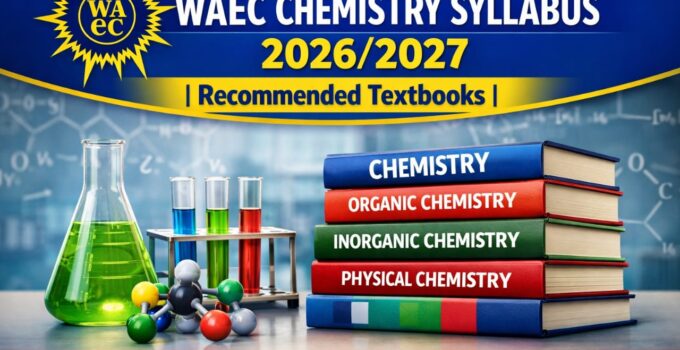
Are you a Students searching on how to Get the complete WAEC Chemistry Syllabus 2026/2027 guide, then you are very lucky to see this. Learn the WAEC Chemistry 2026/2026 exam format, detailed theory and practical topics, recommended textbooks, and smart study tips to pass Chemistry with confidence.
The WAEC Chemistry Syllabus for 2026/2027 is an official framework designed to prepare candidates for one of the most important science subjects in the West African Senior School Certificate Examination (WASSCE). Chemistry plays a vital role in medicine, engineering, agriculture, environmental science, and industrial development, making it a core subject for science-oriented students.
This in-depth guide explains the exam structure, syllabus content, practical requirements, recommended textbooks, and proven preparation strategies. Whether you are a school candidate or a private candidate, understanding this syllabus early will significantly improve your chances of success.
TABLE OF CONTENT
1.Overview of WAEC Chemistry 2026/2027
2. WAEC Chemistry 2026/2027 Examination Structure
3. WAEC Chemistry Syllabus for 2026/2027 Detailed Explanation
4. WAEC Chemistry Practical: What to Expect
5. WAEC Chemistry Recommended Textbooks 2026/2027
6. Smart Tips to Pass WAEC Chemistry Easily
WAEC Chemistry Syllabus for 2026/2027
Overview of WAEC Chemistry 2026/2027
The WAEC Chemistry 2026/2027 is broad and balanced, covering theoretical knowledge, numerical problem-solving, and laboratory skills. The content is grouped into three major areas, students are expected to :
General chemistry principles
Chemical processes and reactions
Specialized branches such as organic, inorganic, and physical chemistry
Candidates are also required to demonstrate competence in Practical laboratory work, which forms a crucial part of the final assessment.
SEE ALSO:
WAEC Physics Syllabus 2026/2027 | Recommended Textbooks
WAEC Biology Syllabus 2026/2027 | Recommended Textbooks
WAEC Further Mathematics Syllabus 2026/2027 & Recommended Textbooks
WAEC Chemistry 2026/2027 (Examination Structure)
The WAEC Chemistry examination consists of three compulsory papers: Papers 1, 2, and 3. Students are expected to answer them in order.
Paper 1: Objective Test
50 multiple-choice questions
Duration: 1 hour
Total marks: 50
Questions are drawn from Section A, which is common to all candidates
Candidates must answer all questions
This paper tests speed, accuracy, and broad knowledge of chemistry concepts.
Paper 2: Essay and Structured Questions
Duration: 2 hours
Total marks: 100
Section A
10 short structured questions
Drawn from the common section of the syllabus
All questions must be answered
25 marks
Section B
4 essay questions provided:
2 from the common section
2 from the country-specific section
Candidates answer any three
25 marks each
Paper 2 assesses understanding, explanation, calculations, and logical presentation.
Paper 3: Practical Chemistry
School candidates: 2 hours
Private candidates: 1 hour 30 minutes (alternative practical)
Total marks: 50
Three compulsory questions:
Quantitative analysis
Qualitative analysis
General laboratory skills
This paper evaluates laboratory competence, observation, accuracy, and safety awareness.
WAEC Chemistry Syllabus for 2026/2027 Detailed Explanation
Below is a simplified and comprehensive explanation of each syllabus area for WAEC Candidates:
1. Introduction to Chemistry
This topic builds the foundation of scientific thinking.
Key areas include:
Measurement of physical quantities
Scientific measurements and their importance
Scientific methods and experimentation
2. Structure of the Atom
Candidates must understand:
Gross features of the atom
Atomic number, mass number, isotopes, and relative atomic mass
Relative molecular mass (Mr) using the carbon-12 scale
Nature and characteristics of matter
Particulate nature of matter and changes (physical vs chemical)
Electron configuration and orbitals
Rules guiding electron filling
3. Separation Techniques for Mixtures
This topic focuses on laboratory methods.
Students should study:
Classification of mixtures
Separation techniques such as filtration, distillation, chromatography, and crystallization
Criteria for determining purity
4. Periodic Chemistry
This section explains element arrangement and behavior.
Areas include:
Periodic law
Periodicity and trends
Classification of elements
Third-period elements (Na–Ar)
Group VII elements (halogens)
Transition metals (Sc–Zn)
Reactions involving acids, metals, oxides, and trioxocarbonates
5. Chemical Bonding
Candidates should understand:
Ionic bonding and properties of ionic compounds
Covalent bonding and properties
Dative covalent bonding
Molecular shapes
Metallic bonding and properties of metals
Intermolecular forces:
Hydrogen bonding
van der Waals forces
Comparison of different bond types
6. Stoichiometry and Chemical Reactions
This topic is calculation-intensive.
Key areas include:
Chemical symbols and equations
Empirical and molecular formulae
Laws of chemical combination
Mole concept and mole ratios
Solutions and concentration terms
Standard solutions
Preparation of solutions by dilution
7. States of Matter
Students must understand:
Kinetic theory of matter
Solids, liquids, vapors, and gases
Gas laws and properties
Diffusion
Preparation and properties of gases
Diamond and graphite structures
Determination of melting points
8. Energy and Energy Changes
This topic covers:
Energy and enthalpy
Exothermic and endothermic reactions
Energy profiles and effects of energy changes
9. Acids, Bases, and Salts
Key concepts include:
Definitions and classifications
Properties of acids and bases
Electrolytes
pH scale
Salt preparation (laboratory and industrial)
Hydrolysis of salts
Indicators and acid-base titrations
10. Solubility of Substances
Students should understand:
Solubility principles
Applications of solubility in chemistry
11. Chemical Kinetics and Equilibrium
This topic includes:
Rate of reaction
Factors affecting reaction rates
Theories of reaction rates
Graph interpretation
Chemical equilibrium
Le Chatelier’s principle
12. Redox Reactions
Candidates must study:
Oxidation and reduction
Oxidizing and reducing agents
Redox equations
Electrochemical cells and EMF
Electrolysis and Faraday’s laws
Corrosion of metals
13. Chemistry of Carbon Compounds (Organic Chemistry)
This is one of the most extensive topics.
Areas include:
Classification of organic compounds
Functional groups
Petroleum and crude oil
Homologous series and isomerism
Alkanes, alkenes, alkynes, benzene
Alkanols, alkanoic acids, alkanoates
Laboratory tests and uses
14. Chemistry, Industry, and the Environment
This topic covers:
Chemical industries
Environmental pollution
Biotechnology and sustainable practices
15. Basic Biochemistry and Synthetic Polymers
Candidates should understand:
Proteins and amino acids
Fats and oils
Soap preparation
Carbohydrates as polymers
Synthetic polymers and their uses
WAEC Chemistry Practical: What to Expect
General Laboratory Skills
Candidates must be familiar with:
Measurement of mass and volume
Preparation of standard solutions
Filtration and recrystallization
pH determination
Rates of reaction experiments
Quantitative Analysis
Includes:
Acid-base titrations
Redox titrations
Calculation of concentration, purity, and molar mass
Qualitative Analysis
Tests include:
Identification of cations and anions
Gas tests
Organic functional group tests
WAEC Chemistry Syllabus 2026/2027 | Recommended Textbooks
Candidates are advised to study from the following trusted textbooks as they are carved from WAEC Chemistry Syllabus 2026/2027:
New School Chemistry – O.Y. Ababio
Senior Secondary Chemistry – Bajah et al.
Understanding Chemistry – G.O. Ojokuku
Essential Chemistry – I.A. Odesina
Countdown to WASSCE/SSCE Chemistry – Uche et al.
These books closely align with the WAEC syllabus and provide extensive practice questions.
Smart Tips to Pass WAEC Chemistry Easily
Practice calculations daily
Understand concepts instead of memorizing
Master laboratory procedures
Study past questions consistently, Most Candidate always visit http://www.Myschool.ng for a CBT TEST on Past Questions.
Revise practical tests and observations, Students are advised to visit the Official WAEC PORTAL https://www.waeconline.org.ng/ for Updated information.
Manage time effectively in exams
CONCLUSION
The WAEC Chemistry Syllabus 2026/2027 is an organized blog for WAEC Candidates, who are Preparing for the Upcoming Examination, the guide was made in essence to help students build confidence before going into the examination hall.
Do well to check this website for the Updated PDF on WAEC Chemistry Syllabus 2026/2027