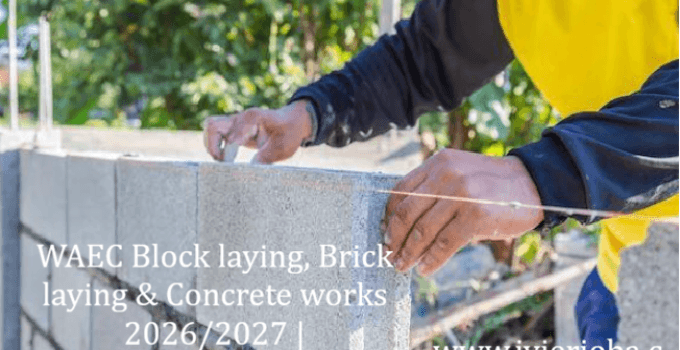
Are you searching for WAEC Block Laying, Brick Laying & Concrete Works Syllabus 2026/2027 | Recommended Textbooks, if Yes? here is the official curriculum designed by the West African Examinations Council (WAEC) to assess candidates’ knowledge and practical skills in masonry, concreting, and basic construction work.
WAEC Block laying, Brick laying & Concrete works Syllabus
OVERVIEW Of WAEC Block Laying, Brick Laying & Concrete Works Syllabus
This subject is one of the most important vocational courses offered at the senior secondary level, especially for students who plan to pursue careers in building construction, civil engineering, masonry, construction management, or skilled trades.
The syllabus combines theoretical knowledge, practical competence, and safety awareness, ensuring that candidates are well prepared for both examinations and real-world construction environments. It also supports self-employment and entrepreneurship, making it highly relevant in today’s job market.
In this comprehensive guide, you will learn:
The WAEC examination structure
A detailed breakdown of the 2026/2027 syllabus
Core areas candidates must focus on
Practical skills required for Paper 3
How to prepare effectively and pass the exam
RAED ALSO
WAEC Building Construction Syllabus 2026/2027 | Recommended Textbooks
WAEC Ceramics Syllabus 2026/2027 | Recommended Textbooks
WAEC Block Laying, Brick Laying & Concrete Works Examination Guidelines
The examination consists of three compulsory papers. Candidates must take all three papers to be graded.
Paper 1: Objective Test
Duration: 45 minutes
Marks: 40
Paper 1 contains 40 multiple-choice questions, all of which must be answered. The questions test candidates’ understanding of:
Safety practices
Tools and equipment
Construction materials
Basic construction processes
Terminologies used in block laying and concreting
Paper 2: Short-Structured Essay
Duration: 1 hour
Marks: 60
Paper 2 consists of five short-structured questions.
Candidates are required to answer any four questions.
This paper focuses on:
Explanation of construction methods
Description of tools and materials
Application of theory to practical construction scenarios
Paper 3: Practical Test
Duration: 3 hours
Marks: 100
Paper 3 is a hands-on practical examination. Candidates are required to produce a workpiece, which may involve:
Laying blocks
Laying bricks
Composite walling (blocks and bricks)
Workpiece limits:
Blocks only: not more than 30 blocks
Bricks only: not more than 100 bricks
Composite walling: not more than 20 blocks and 40 bricks
Accuracy, alignment, bonding, workmanship, and safety are carefully assessed.
2026/2027 WAEC Block Laying, Brick Laying & Concrete Works Syllabus (Detailed Breakdown)
Below is a clear and simplified explanation of each topic in the syllabus for Candidate who are preparing to seat for the upcoming Examination:
1. Workshop and Site Safety
Safety is a foundation topic in this syllabus.
Key Areas:
Safety rules on construction sites
Purpose and importance of safety
First aid procedures
Safety regulations for:
Scaffolding
Electrical installations
Use of tools and machines
Personal protective equipment (helmets, gloves, boots, goggles)
Candidates must understand how safety prevents accidents and protects lives.
2. Basic Tools and Equipment
This topic introduces the tools used in block laying, brick laying, and concreting.
Content Includes:
Identification of basic hand tools
Site preparation and levelling tools
Finishing tools
Sketching of basic tools
Uses of tools and equipment
Simple maintenance practices
Proper tool handling improves efficiency and workmanship
3. Site Preparation and Setting-Out
This section explains how a construction site is prepared before building begins.
Key Topics:
Tools and equipment used for site preparation
Clearing of vegetation and debris
Methods of setting out
Setting-out tools and materials
Importance of accuracy during setting out
4. Manufacture, Application, and Properties of Blocks and Bricks
Candidates learn how walling materials are produced and used.
Topics Covered:
Manufacturing processes of blocks and bricks
Types of blocks and bricks
Materials used:
Sand
Cement
Lime
Clay
Laterite
Water
Properties and applications of blocks and bricks
5. Concreting Materials
Concrete is a core component of construction work.
Areas Covered:
Constituents of concrete
Types of cement
Fine and coarse aggregates
Differences between fine and coarse aggregates
Storage of concrete materials to prevent deterioration
6. Formwork for Construction Work
Formwork provides shape and support for concrete.
Key Areas:
Functions and requirements of formwork
Materials used for formwork
Advantages of steel and timber formwork
Construction of formwork for:
Floor slabs
Beams
Columns
Arches
Lintels
Staircases
Erection and striking of formwork
7. Concreting Operations
This topic explains how concrete is produced and used on site.
Topics Include:
Mix proportions
Cement-aggregate ratios
Water-cement ratio
Stages of concreting:
Batching
Mixing
Transporting
Placing
Curing
Transportation of wet concrete
Concrete testing
Properties of concrete
Construction joints
Need for reinforcement
Types of steel reinforcement bars
In-situ and precast concrete
Casting and curing of concrete structures
8. Substructure Construction and Ground Floors
Candidates learn about building below ground level.
Key Topics:
Types of soil
Site and soil investigation
Bearing capacity of soil
Foundations: types and uses
Ground floors: definition, types, and construction
Damp Proof Course (D.P.C.)
Damp Proof Membrane (D.P.M.)
Differences between D.P.C. and D.P.M.
Methods of placing D.P.C.
9. Upper Floors
This section focuses on construction above ground level.
Content Includes:
Functions of floors
Types of floors
Construction methods
Flooring types and applications
10. Walls
Walls provide enclosure and support.
Topics Covered:
Functions and types of walls
Walling materials
Common bonding patterns
Mortar types and mix ratios
Differences between pointing and jointing
Types of pointing and jointing
11. Openings in Walls
This topic explains doors, windows, and other openings.
Key Areas:
Functions and types of openings
Lintels, beams, and arches
Doors and windows:
Types
Materials
Fixing methods
Ironmongery used in doors and windows
12. Stair Construction
Candidates learn the basics of stair construction.
Content Includes:
Types of stairs
Construction of a straight flight stair
13. Scaffold and Scaffolding
Scaffolding ensures safe working at height.
Topics Include:
Types of scaffolds
Scaffold components
Hoisting equipment
Safety regulations
14. Finishes
This section explains surface finishing.
Key Topics:
Types of finishes
Finishing materials
Characteristics and uses
Care and maintenance of finishes
15. Construction of Drainage Systems
Candidates learn basic drainage principles.
Areas Covered:
Principles of good drainage
Types of drainage systems
Differences between a sewer and a drain
Simple sketches of:
Septic tanks
Soakaway pits
Manholes
Surface drainage
Laying drain pipes to a specified gradient
16. Kerbs
This topic covers external works.
Key Areas:
Functions and types of kerbs
Materials used in kerb production
Methods of laying precast concrete kerbs
17. Business Opportunities in Building
This section promotes entrepreneurship.
Topics Include:
Career opportunities in the building industry
Procedures for starting a construction business
Requirements for managing a construction business
Cost estimation
Principles of bookkeeping
How to Prepare and Pass WAEC Block Laying, Brick laying & Concrete Works for 2026/2027
Practice practical work regularly
Master safety rules
Understand concrete mix ratios
Learn bonding patterns and finishing techniques
Revise past WAEC questions by Visiting http://www.Myschool.ng or by visiting the Official WAEC E-Learning portal https://www.waecnigeria.org/
Conclusion
The WAEC Block Laying, Brick Laying & Concrete Works Syllabus 2026/2027 | Recommended Textbooks equips candidates with practical skills, technical knowledge, and entrepreneurial awareness. With proper preparation and hands-on practice, students can excel in the examination and build a strong foundation for careers in the construction industry.