
Most students preparing for the 2026 JAMB UTME are searching for key information such as JAMB Use of English syllabus, JAMB English syllabus 2026/2027 – is it out?, JAMB English recommended textbooks, JAMB Use of English questions and answers, JAMB English past questions, JAMB English exam guide, complete JAMB English syllabus 2026/2027, and simple explanations of JAMB English topics.
Other popular searches by JAMB candidates include:
-
How to pass JAMB Use of English
-
JAMB Use of English tips and tricks
-
Where to get JAMB English past questions and answers
-
JAMB English syllabus PDF download
-
JAMB Use of English topics and subtopics explained
-
JAMB English practice questions for 2026 UTME
But, This article focuses specifically on the JAMB Use of English (English Language) syllabus 2026/2027
The Use of English is a compulsory subject for all candidates writing the JAMB UTME, regardless of their chosen course of study.
A good score in this subject is very important because it affects the overall JAMB result.
What Is JAMB Use of English?
JAMB Use of English is designed to test how well candidates can read, understand, and use the English language correctly. The questions are set to examine a candidate’s ability to understand passages, apply grammar rules, interpret meanings, and recognize correct pronunciation.
Unlike some other subjects, Use of English is not about memorizing facts. Instead, it tests understanding, reasoning, and language skills.
Aims and Objectives of the JAMB Syllabus for Use of English.
The main aim of the JAMB Use of English syllabus is to ensure that candidates can use English effectively for communication and academic purposes.
By studying this syllabus, candidates should be able to:
-
Understand written English clearly
-
Use correct grammar and sentence structure
-
Choose appropriate words in different situations
-
Interpret passages and sentences correctly
-
Recognize correct pronunciation and stress patterns
-
Appreciate simple literary texts
-
Communicate ideas clearly in English
Structure of the JAMB Use of English Syllabus
The JAMB syllabus for Use of English is divided into several key areas. Each area tests a different aspect of the English language.
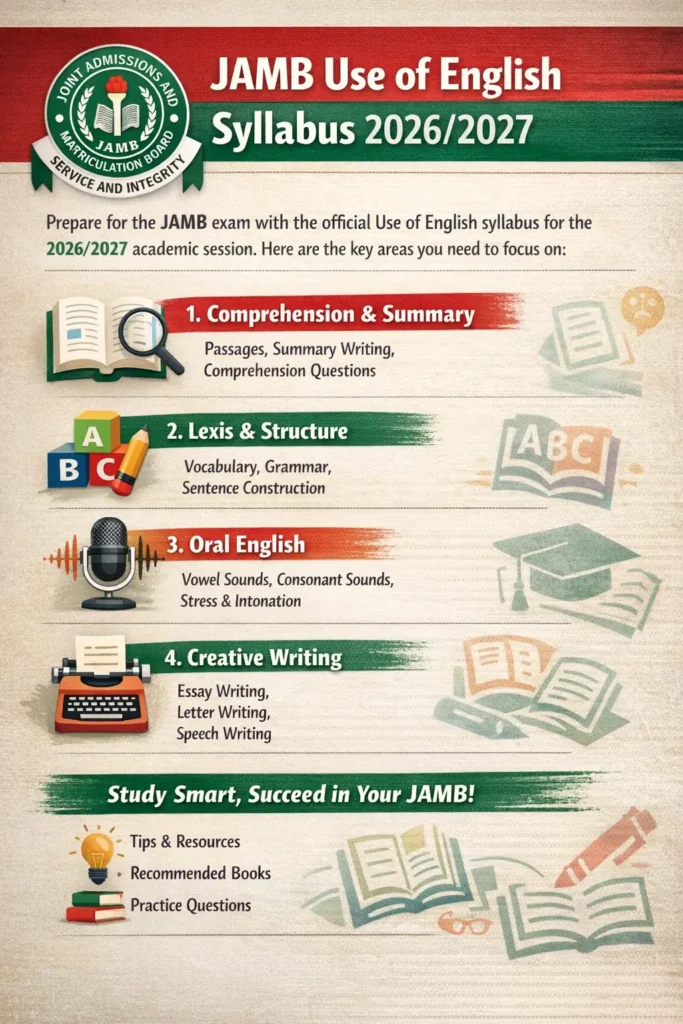
1. Comprehension and Summary
This is one of the most important parts of the Use of English paper.
Candidates are expected to:
-
Read passages carefully
-
Understand the message in a passage
-
Answer questions based on the passage
-
Identify main ideas and supporting details
-
Draw correct conclusions from what they read
Passages may come from:
-
Newspapers
-
Magazines
-
Short stories
-
Educational articles
To do well in this section, candidates must practice reading with understanding, not just reading fast.
2. Lexis and Structure (Vocabulary and Grammar)
This section tests how well candidates understand grammar rules and word usage.
It covers areas such as:
-
Meaning of words in context
-
Synonyms (words with similar meanings)
-
Antonyms (words with opposite meanings)
-
Sentence structure
-
Parts of speech
-
Verb tenses
-
Subject and verb agreement
-
Correct use of punctuation
Candidates are advised to focus on how words are used in sentences, not just their dictionary meanings.
3. Sentence Interpretation
In this section, candidates are tested on their ability to:
-
Understand the meaning of sentences
-
Choose sentences that best explain a given idea
-
Rewrite sentences without changing their meaning
-
Identify correct expressions
This section requires careful thinking, as many options may look correct at first glance.
4. Oral Forms (Oral English)
Oral English tests knowledge of spoken English, even though the exam is written.
Candidates should understand:
-
Vowel sounds
-
Consonant sounds
-
Word stress
-
Sentence stress
-
Intonation
-
Rhyming words
This section helps candidates pronounce words correctly and understand spoken English better.
5. Figures of Speech
Figures of speech are expressions used to make language more interesting.
Candidates should understand common figures of speech such as:
-
Simile
-
Metaphor
-
Personification
-
Irony
-
Hyperbole
Questions in this area test the ability to recognize and interpret meanings, not to memorize definitions alone.
6. Registers (English for Different Situations)
Registers refer to how English is used in different settings.
Candidates are expected to understand English used in places such as:
-
Schools
-
Offices
-
Hospitals
-
Markets
-
Law courts
-
Media houses
This section tests whether candidates can choose the appropriate words and expressions for different situations.
7. Literary Appreciation
This section introduces candidates to basic literary knowledge.
Candidates may be tested on:
-
Short prose passages
-
Simple poems
-
Drama extracts
-
Basic literary terms
The focus here is on understanding, not detailed literary criticism.
SEE ALSO:
Summary of the JAMB Use of English Syllabus
| Section | Main Focus |
|---|---|
| Comprehension | Understanding passages and answering questions |
| Vocabulary & Grammar | Correct word usage and sentence structure |
| Oral English | Pronunciation, stress, and intonation |
| Registers | English usage in different situations |
| Literary Appreciation | Basic understanding of literary texts |
Why the JAMB Use of English Syllabus Is Important
The JAMB Use of English syllabus is important because:
-
It is compulsory for all JAMB candidates
-
It influences the total JAMB score
-
It improves understanding of other subjects
-
It guides candidates on what to study
-
It helps students avoid unnecessary reading
Tips for Passing JAMB Use of English
Here are simple tips to help candidates perform well:
-
Read English materials daily
-
Practice JAMB past questions regularly
-
Improve vocabulary gradually
-
Understand grammar rules clearly
-
Read questions carefully before answering
-
Manage time properly during the exam
CLICK HERE TO JOIN OUR TELEGRAM CHANNEL
Conclusion
The JAMB Use of English syllabus 2026/2027 is designed to test real understanding of the English language. Candidates who study according to the syllabus, practice regularly, and read widely have a higher chance of scoring well.
Related
Table of Contents
Toggle