
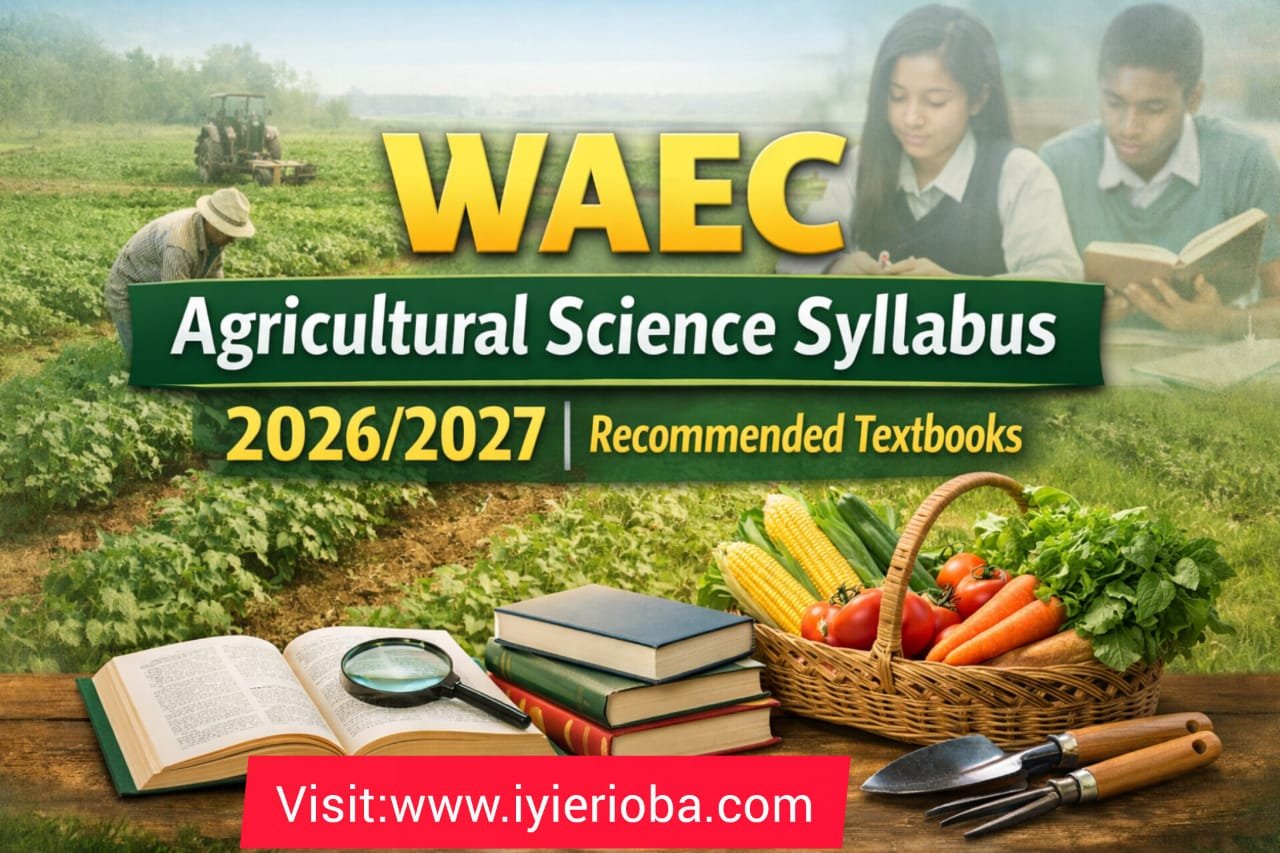
Finally WAEC has released their WAEC Agricultural Science Syllabus 2026/2027 | Recommended Textbooks. The syllabus covers a wide range of topics, including crop production, animal health, soil science, agricultural engineering, agricultural economics, and extension services. It is carefully structured to test students’ understanding of agricultural concepts while also assessing their practical competence.
In this guide, you will find a clear explanation of the aims and objectives WAEC Agricultural Science Syllabus, scheme of examination, major syllabus themes, practical requirements, and recommended textbooks for effective preparation. The WAEC Agricultural Science Syllabus 2026/2027 is a comprehensive guide designed for Senior Secondary School students preparing for the West African Senior School Certificate Examination (WASSCE). Agricultural Science is both a theoretical and practical subject, aimed at equipping students with foundational knowledge and hands-on skills relevant to modern agriculture.
TABLE OF CONTENTS
1.Overview of the WAEC Agricultural Science Syllabus 2026/2027
2. Aims and Objectives of WAEC Agricultural Science
3. Scheme of Examination for WAEC Agricultural Science 2026/2027
4. WAEC Agricultural Science Syllabus 2026/2027: Major Topics Explained
4i. Practical Agricultural Science (Skills and Laboratory Work)
5. WAEC Agricultural Science 2026/2027 Textbooks
6. How to Prepare Effectively for WAEC Agricultural Science
Overview of the WAEC Agricultural Science Syllabus 2026/2027
Agricultural Science is examined through three compulsory papers, all of which candidates must take:
-
Paper 1: Objective (Multiple Choice)
-
Paper 2: Essay (Theory)
-
Paper 3: Practical or Alternative to Practical
Papers 1 and 2 are taken together as a composite paper, while Paper 3 focuses on practical agricultural skills.
The syllabus emphasizes:
-
Agricultural productivity and sustainability
-
Scientific farming methods
-
Environmental management
-
Economic principles in agriculture
-
Practical farm and laboratory skills
Aims and Objectives of WAEC Agricultural Science
The main objectives of the Agricultural Science syllabus are to:
-
Stimulate and sustain students’ interest in agriculture
-
Equip students with functional knowledge of agricultural principles
-
Develop practical skills needed for farming and agribusiness
-
Prepare students for further studies and careers in agriculture
-
Promote understanding of agriculture’s role in national development
These objectives reflect the growing importance of agriculture in food security, employment, and economic growth.
Scheme of Examination for 2026/2027 WAEC Agricultural Science
The examination consists of three papers, all of which are compulsory.
Paper 1: Objective Test
-
Duration: 50 minutes
-
Marks: 50
Paper 1 consists of 50 multiple-choice questions covering the entire syllabus. It tests candidates’ understanding of basic agricultural concepts, definitions, and principles across all themes.
Paper 2: Essay (Theory) Paper
-
Duration: 2 hours 10 minutes
-
Marks: 90
Paper 2 comprises six essay questions, each drawn from at least two syllabus themes. Candidates are required to answer five questions.
This paper tests:
-
Depth of understanding
-
Ability to explain agricultural processes
-
Application of theory to real-life agricultural situations
Paper 3: Practical / Alternative to Practical
-
Duration: 1½ hours
-
Marks: 60
Paper 3 is:
-
A practical examination for school candidates
-
An alternative to practical for private candidates
It consists of four compulsory questions testing practical skills, observation, identification, and simple experiments related to agriculture.
WAEC Agricultural Science Syllabus 2026/2027 Major Topics Explained
1. Introduction to Agriculture
This section introduces students to the foundation of agricultural science.
Key Areas Covered
-
Meaning and branches of agriculture
-
Importance of agriculture to individuals, communities, and nations
-
Problems of agricultural development (land tenure, finance, storage, transportation, tools, education, environmental degradation)
-
Practical solutions to agricultural challenges
Students also learn the differences between:
-
Subsistence agriculture
-
Commercial agriculture
The role of government and non-governmental organizations (NGOs) in agricultural development, including policies, subsidies, credit facilities, and extension services, is emphasized.
2. Agricultural Ecology
Agricultural ecology focuses on the interaction between living organisms and their environment.
Topics Include
-
Meaning and importance of agricultural ecology
-
Components of farm ecosystems (biotic and abiotic)
-
Uses and characteristics of land
-
Factors affecting land availability (physical, economic, socio-cultural)
Students study:
-
Environmental factors such as climate, soil, and organisms
-
Rock and soil formation processes
-
Soil profile development
-
Types, composition, and properties of soil
This section also covers plant nutrients, nutrient cycles, organic agriculture, irrigation, drainage, and agricultural pollution.
3. Agricultural Engineering and Mechanization
This theme introduces students to tools, machinery, and farm power.
Areas of Study
-
Simple farm tools and maintenance
-
Farm machinery and tractor-coupled implements
-
Agricultural mechanization and its advantages and limitations
-
Sources of farm power
-
Farm surveying equipment and uses
-
Farm planning and farmstead layout
Students learn how mechanization improves efficiency while understanding its economic and environmental implications.
4. Crop Production and Protection
This is one of the most detailed sections of the syllabus.
Core Topics
-
Classification of crops by use, life cycle, and morphology
-
Husbandry of selected crops (cereals, legumes, roots, vegetables, fruits, beverages, fibres, oils, latex)
-
Pasture and forage crops
-
Crop improvement and basic genetics
-
Forestry and agro-forestry practices
-
Ornamental plants and landscaping
Students also study:
-
Crop diseases and their control
-
Pests and pest management
-
Weeds and weed control methods
This section builds strong knowledge of plant production and protection strategies.
5. Animal Production and Health
This section covers livestock and aquatic animals.
Topics Include
-
Types and classification of farm animals
-
Anatomy and physiology of animals
-
Animal reproduction and hormones
-
Environmental physiology
-
Livestock management practices
-
Animal nutrition and feeding
Students also learn about:
-
Rangeland and pasture management
-
Animal improvement methods
-
Animal diseases and parasites
-
Aquaculture and fisheries
-
Apiculture (bee-keeping)
This theme emphasizes animal welfare, productivity, and disease control.
6. Agricultural Economics and Extension
This section introduces students to the economic and managerial aspects of agriculture.
Key Concepts
-
Basic economic principles (scarcity, choice, diminishing returns)
-
Demand and supply
-
Farm management functions
-
Agricultural finance and credit
-
Capital markets and agribusiness funding
Other areas include:
-
Farm records and accounts
-
Agricultural marketing
-
Agricultural insurance
-
Agricultural extension services and programs
Students gain insight into agricultural business management and rural development.
SEE ALSO:
WAEC Animal Husbandry Syllabus 2026/2027 | Recommended Textbooks
WAEC Civic Education Syllabus 2026/2027 | Recommended Textbooks
WAEC Biology Syllabus 2026/2027 | Recommended Textbooks
Practical Agricultural Science (Skills and Laboratory Work)
The practical component tests hands-on skills, including:
-
Soil analysis and identification
-
Farm tools and equipment handling
-
Crop propagation and pest identification
-
Animal breeds, organs, feeds, and diseases
-
Routine farm management practices
-
Fish harvesting and preservation
Practical skills are essential for achieving high scores in Paper 3.
WAEC Agricultural Science Textbooks 2026/2027
Students are encouraged to study approved textbooks that comprehensively cover the syllabus.
Recommended Textbooks Includes:
-
Countdown to SSCE Agricultural Science – Evans
-
Senior Secondary Agricultural Science – Longman
-
General Agriculture for West Africa – George Allen
-
Comprehensive Certificate Agricultural Science – University Press
-
Agricultural Science for Senior Secondary Schools – University Press Ltd
-
Agricultural Notebook – Longman
Using multiple textbooks enhances understanding and exam readiness.
How to Prepare Effectively for WAEC Agricultural Science
-
Study the syllabus topic by topic
-
Practice multiple-choice questions regularly
-
Write structured essay answers
-
Engage actively in practical farm work
-
Use diagrams where necessary
-
Revise past questions and marking schemes. If you are interested, students can Practice an Online CBT TEST via http://www.Myschool.ng
Consistent practice improves both theory and practical performance.
Career Opportunities in Agricultural Science
Agricultural Science opens doors to careers in:
-
Crop and animal production
-
Agricultural engineering
-
Agribusiness and marketing
-
Agricultural extension services
-
Environmental management
-
Food processing and storage
It also provides a strong foundation for tertiary studies in agriculture and related fields.
You can Download the PDF for easy access AGRICULTURAL-SCIENCE-1
Conclusion
The WAEC Agricultural Science Syllabus 2026/2027 | Recommended Textbooks is designed to produce students who are knowledgeable, skilled, and prepared for modern agricultural challenges. By mastering both theoretical concepts and practical skills outlined in the syllabus, candidates can achieve excellent results and build a strong foundation for future careers. Although the Recommended Textbooks are Released, Students are advised to always visit the official WAEC PORTAL https://www.waeconline.org.ng/ for updated information concerning the WAEC Agricultural Science Textbooks 2026/2027.