
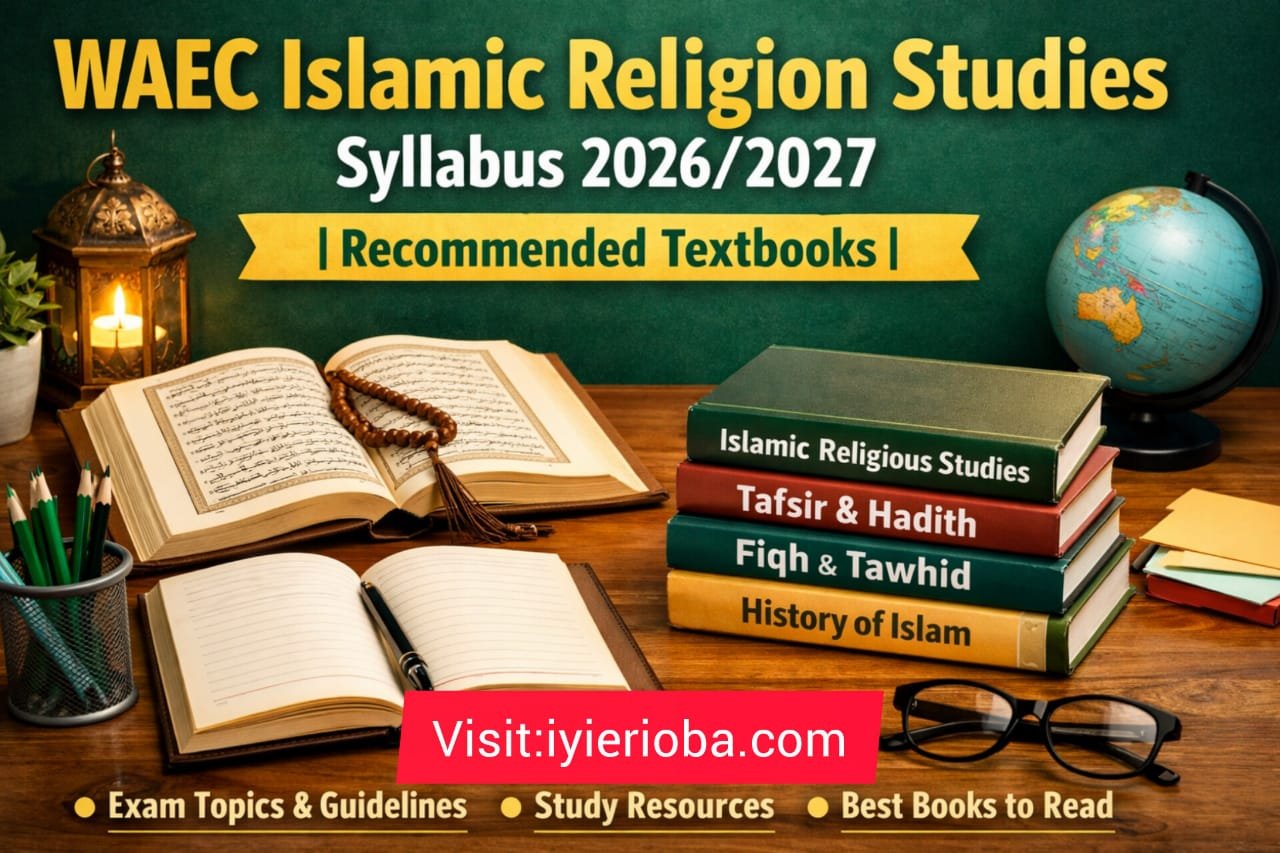
This is Strictly for Hausa speaking Candidates, The WAEC Islamic Religious Studies Syllabus 2026/2027 (IRS). it is an academic framework designed to equip candidates with a deep understanding of Islam as a religion, a way of life, and a socio-moral system, Candidates learn the historical development of Islam, the life and mission of Prophet Muhammad (S.A.W.), the Qur’an and Hadith, and the practical application of Islamic teachings in personal and societal life.
This guide provides a detailed explanation of the WAEC IRS examination structure, a complete breakdown of the syllabus topics, and a list of recommended textbooks, helping students, teachers, and parents prepare effectively for the examination.
TABLE OF CONTENTS
1.Overview of the WAEC Islamic Religious Studies Syllabus 2026/2027
2. Objectives of the WAEC IRS Syllabus
3. WAEC Islamic Religious Studies Examination Guide (Structure)
4. WAEC Islamic Religious Studies (IRS) Syllabus 2026/2027 – Detailed Breakdown
5. WAEC Islamic Religious Studies Textbooks 2026/2027
6. Tips for Excelling in WAEC Islamic Religious Studies and Conclusion
Overview of the WAEC Islamic Religious Studies Syllabus 2026/2027
WAEC IRS syllabus is structured to assess candidates’ understanding of the following:
-
The origin and spread of Islam
-
Islamic beliefs and practices
-
Moral, spiritual, and social values in Islam
-
Islamic law (Shari‘ah) and jurisprudence (Fiqh)
-
Family life, marriage, and divorce in Islam
-
The Qur’an and Hadith as primary sources of guidance
The WAEC Islamic Religious Studies syllabus balances theoretical knowledge with practical application, encouraging students to apply Islamic teachings responsibly in their daily life.
Objectives of the WAEC IRS Syllabus
For WAEC Candidates, After studying this syllabus, candidates should be able to:
-
Understand the historical and contemporary development of Islam
-
Explain the life, mission, and leadership qualities of Prophet Muhammad (S.A.W.)
-
Appreciate the moral, spiritual, socio-economic, and intellectual roles of Islam in society
-
Apply Islamic teachings to real-life situations
-
Demonstrate knowledge of Islamic beliefs, worship, and jurisprudence
These objectives ensure that students develop both academic competence and moral awareness.
SEE ALSO:
WAEC Civic Education Syllabus 2026/2027 | Recommended Textbooks
WAEC Textiles Syllabus 2026/2027 | Recommended Textbooks
WAEC Animal Husbandry Syllabus 2026/2027 | Recommended Textbooks
WAEC Islamic Religious Studies Examination Guide (Structure)
The WAEC Islamic Religious Studies examination consists of two papers, taken together as a composite paper in one sitting.
PAPER 1: Objective Test
-
Duration: 50 minutes
-
Total Marks: 50
-
Format: 50 multiple-choice questions
Paper 1 tests candidates’ general understanding of all areas of the syllabus, including history, Qur’an, Hadith, Tawhid, Fiqh, and Islamic practices.
PAPER 2: Essay Paper
-
Duration: 2 hours
-
Total Marks: 100
-
Questions: Six essay questions
One question is compulsory, and candidates must answer it along with any three of the remaining questions. Paper 2 assesses Candidates depth of knowledge, clarity of explanation, and ability to apply Islamic teachings.
WAEC Islamic Religious Studies (IRS) Syllabus 2026/2027 (Detailed Breakdown)
PART 1: Tarikh (Historical Development of Islam)
1. Jahiliyyah (Arabia Before Islam)
Candidates study pre-Islamic Arabia, including:
-
Social life (marriage, divorce, inheritance)
-
Religious practices (idol worship and major deities)
-
Political and economic systems
-
Reforms introduced by Islam
2. Life of Prophet Muhammad (S.A.W.)
Key topics include:
-
Birth and early life
-
Marriage and call to prophethood
-
Hijrah and its significance
-
Formation of the Ummah and Madinan Constitution
-
Major battles (Badr, Uhud, Khandaq)
-
Treaty of Hudaybiyyah
-
Conquest of Makkah
-
Farewell Pilgrimage and sermon
-
Death and lessons from his life
3. The Rightly Guided Caliphs (Khulafā’ur-Rāshidīn)
-
Abu Bakr
-
Umar ibn al-Khattab
-
Uthman ibn Affan
-
Ali ibn Abi Talib
Candidates study their biographies, contributions, and leadership lessons.
4. Islam in West Africa
-
Spread of Islam through trade, scholarship, and reform movements
-
Role of Islamic scholars and pilgrims
-
Impact of Islam on governance, economy, education, and language
PART 2: The Qur’an
Topics include:
-
Revelation of the Qur’an
-
Compilation, preservation, and standardization
-
Makki and Madani chapters
-
Importance of the Qur’an as a guide
Candidates are expected to read, memorize, interpret, and apply selected Surahs such as:
-
Suratul-Fatihah
-
Suratul-Duha
-
Suratul-Tin
-
Suratul-Alaq
-
Suratul-Qadr
-
Suratul-Ikhlas
-
Suratul-Falaq
-
Suratun-Nas
Moral lessons focus on:
-
Respect for parents
-
Honesty and integrity
-
Prohibition of gambling
PART 3: Hadith
Candidates learn:
-
Definition and importance of Hadith and Sunnah
-
Differences and similarities between them
-
Classification of Hadith (Sahih, Hasan, Da‘if)
-
Components of Hadith (Isnad, Matn, Rawi)
-
The six authentic collections (Sihah al-Sittah)
Selected Hadith from An-Nawawi’s collection are studied for memorization, interpretation, and application.
PART 4: Tawhid and Fiqh (Islamic Theology and Jurisprudence)
1. Iman (Faith)
-
Belief in Allah
-
Angels
-
Holy Books
-
Prophets
-
Day of Judgment
-
Qada’ and Qadar
2. Shirk
-
Idol worship
-
Ancestor and hero worship
3. Taharah (Purification)
-
Istinja’
-
Wudu’
-
Tayammum
-
Ghusl
4. Salat (Prayer)
-
Importance and conditions
-
Types of prayers (obligatory, voluntary, special prayers)
5. Sawm (Fasting)
-
Ramadan fast
-
Voluntary and compulsory fasting
-
Benefits of fasting
6. Zakat (Charity)
-
Nisab
-
Zakat on wealth, livestock, crops
-
Beneficiaries of Zakat
7. Hajj and Umrah
-
Types of Hajj
-
Rites and significance
8. Shari‘ah
-
Sources: Qur’an, Sunnah, Ijma’, Qiyas
-
Importance in society
9. Nikah (Marriage)
-
Conditions
-
Rights and responsibilities
-
Prohibition of ill-treatment
10. Talaq (Divorce)
-
Islamic perspective
-
Types of divorce
-
Waiting period (Iddah)
WAEC Islamic Religious Studies Syllabus 2026/2027 | Recommended Textbooks
Recommended Textbooks include:
-
The Holy Qur’an (Yusuf Ali, Pickthall)
-
Islamic Religious Knowledge series for WASC and SSS
-
The Life of Muhammad by Haykal
-
Islam in Focus by Hammudah Abdalati
-
Selected Traditions of An-Nawawi
-
History of Islam in West Africa by J.S. Trimingham
Students are encouraged to use multiple Textbooks for deeper understanding. Which must be in line with WAEC Islamic Religious Studies Syllabus 2026/2027 Textbooks
Tips for Excelling in 2026/2027 WAEC Islamic Religious Studies Examination (IRS)
-
Memorize key Qur’anic verses and Hadith
-
Understand concepts, not just definitions
-
Practice past WAEC essay questions, Candidates can visit http://www.Myschool.ng for an Online CBT TEST Practice on all Subjects.
-
Learn practical applications of Islamic teachings
-
Study historical events with lessons attached
- Candidates are advised to visit the WAEC OFFICIAL E-learning PORTAL https://www.waeconline.org.ng/ For Updated information.
Conclusion
The 2026/2027 WAEC Islamic Religious Studies Syllabus offers students a structured path to mastering Islamic history, beliefs, worship, and moral values. With proper preparation, consistent revision, and the right textbooks, candidates can achieve excellent results while gaining lifelong spiritual and ethical guidance.